Photochromic lenses
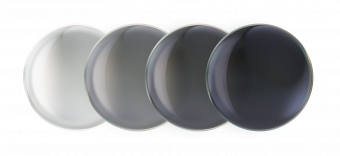
Self-tinting lenses are the solution for anyone who plays sports or travels in changing light conditions. Whereas you would normally have to carry several pairs of glasses or separate lenses, one pair of Photochromic lenses glasses automatically adjusts to the environment. This means: clear lenses when the sun disappears behind the clouds or you are driving in a forest, and dark lenses as soon as the sun shines brightly. For athletes, motorcyclists and professionals alike, this means ultimate comfort, safety and convenience – always the right vision without having to change lenses. Self-tinting lenses are available in different colors and designs.
The technology behind self-tinting lenses
How do self-tinting lenses work?
Self-tinting lenses work by phototropic molecules that react to UV radiation and (in more advanced variants) to the intensity of visible light.
- Under the influence of UV, the molecules change shape, absorbing more light and darkening the glass.
- Once the UV intensity decreases, the molecules slowly return to their original form, restoring clarity to the lens.
- This process happens automatically and can be repeated numerous times without losing its effect.
Self-tinting lenses provide proper UV protection under all conditions.
How long does it take for self-tinting sunglasses to go from light to dark?
Modern self-tinting lenses tint up in just 25 seconds and back about twice as fast as previous generations. We are now working with the 9th generation of self-tinting lenses. These have a lightning-fast fading time of only 25 seconds¹ and a fading back time of about 2 minutes, which is twice as fast as the previous generation². Transitions® GEN S™ thus offers unmatched performance.
The first photochromatic lenses were launched in 1964. At that time, spectacle lenses began to react only after a few minutes and reached their maximum color only after about 15 minutes. Also, these lenses remained darker as they aged. Fortunately, this has improved tremendously.
Benefits of Photochromic lenses in sports glasses
Why co-coloring in sports?
Imagine this: you get on your bike for a long ride. In the forest, you benefit from clear glass to see roots and branches clearly. As soon as you reach an open field or mountain pass, the glass automatically changes to a darker shade that protects your eyes from bright sunlight.
- Self-tinting sports glasses without prescription: ideal for extra comfort and convenience. One pair of glasses for all conditions.
- Self-tinting prescription sports glasses: even more benefit, because you don’t have to buy or carry multiple pairs of prescription glasses.
Benefits of Photochromic motorcycle glasses
Why Photochromic lenses when motorcycling?
For motorcyclists, self-tinting lenses are a godsend. You set off in cloudy weather or at dusk with clear lenses, but along the way the sun breaks through and your glasses automatically darken. Take a longer drive that ends in darkness? Then your glasses clear again, so you get home safely.
Please note that not all self-tinting lenses work behind a motorcycle visor. For self-tinting prescription glasses for motorcyclists, we recommend Transitions XTRActive, which reacts not only to UV but also to light intensity, causing the lens to partially darken behind the visor. In full sunlight, this lens darkens even more.
Benefits of self-tinting safety glasses
Lighting conditions are also often underestimated in industry and construction. Workers walk outside in bright sunlight one minute and into a hallway or workshop the next. Self-tinting safety glasses ensure that vision adjusts instantly: dark in bright sunlight outside, bright enough inside. As a result, the glasses are worn longer and safer.
Pros and cons of self-tinting lenses
The benefits
- One pair of glasses for all conditions – no need to switch between sunglasses and clear glasses.
- Always 100% UV protection – even in cloudy or indirect sunlight.
- Contrast enhancement at Category 1 as a base – provides better visibility in shaded and cloudy situations.
- Suitable for sports, motorcycle and safety – adapts to any situation.
The disadvantages
Strong UV without bright sunlight – in cloudy weather, the lens may turn dark despite little visible sunlight.
Coloring back takes a while – it may look like you still have sunglasses on inside.
Behind car windows/visors less effective – unless you choose Transitions XTRActive.
Different types of self-tinting technology.
There are different types of self-tinting lenses for different applications. These differ in the rate of discoloration, how dark they become and whether they also respond to light intensity.
| Technology | Speed up coloring | Back coloring up to 25% | Coloring back to clear | Operates on light intensity | Available in category | ||
|---|---|---|---|---|---|---|---|
| 0-3 | 1-3 | 2-4 | |||||
| Transitions GEN S | 30-40 sec | 60 sec | 2-3 min | no | ✓ | ✗ | ✗ |
| Transitions XTRActive | 30-60 sec | 60 sec | 3-4 min | yes | ✓ | ✗ | ✗ |
| Oakley Prizm React | 30-40 sec | 60 sec | 2-3 min | no | ✓ | ✗ | ✗ |
| Julbo Reactiv | 20-30 sec | 50 sec | 1-2 min | yes | ✓ | ✓ | ✓ |
| Gloryfy TRF | 40-70 sec | 60 sec | 2-3 min | no | ✗ | ✓ | ✓ |
| Generic multicoloring | 1-2 min | 2-3 min | 5-7 min | no | ✓ | ✗ | ✗ |
* Speed is indicative based on own findings
Conclusion: one pair of glasses for all conditions
Self-tinting lenses are ideal for sports, motorcycling and safety. They offer maximum comfort and protection: from clear in dark conditions to dark in bright sunlight. Thanks to technologies such as Transitions GEN S and XTRActive, or sporty alternatives like Reactiv, there is always a suitable solution.
Choose self-tinting sports glasses, motorcycle glasses or safety glasses and experience for yourself the convenience of one pair of glasses that always moves with your surroundings.