


Article
From curling springs to smart AI glasses

wolter


Innovation in sports glasses
Sports and sight have been a part of each other for centuries. Whether you go running, cycling, skiing or paddling: good vision makes you faster, safer and more confident. The development of prescription sports glasses has made a huge leap in this regard. Where you used to have to make do with a simple pair of metal glasses with curly springs, today you can choose from high-tech sports solutions with smart AI functions that coach you while you exercise.
In the early years, there simply were no real sports glasses. You wore your everyday glasses during sports, with narrow metal frames, lenses that fogged up and curling springs behind your ears in an attempt to keep everything in place. It worked, but it wasn’t ideal: your glasses fell off due to sweat, the lenses were fragile, and wind, dust and insects got in from all sides. Still, for years this was the only option.
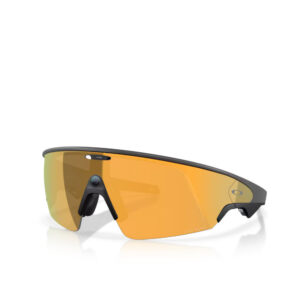
It wasn’t until the 1980s and 1990s that the first true sports glasses emerged. Brands like Oakley and Rudy Project began to develop glasses that were light, fit your face better and had a curved screen for a wide, panoramic view. For eyeglass wearers, the first solutions came: inset clips, small adapters or lenses cut specifically for sports frames. Suddenly you could really play sports without having to constantly push up your glasses.
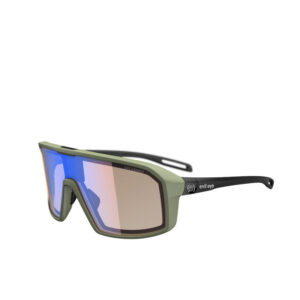
Today, prescription sports glasses are completely advanced. You can have them made with fully prescription sports lenses, inset clips for those who want to change lens colors, shock-resistant materials and coatings that repel water, dirt and sweat. Thanks to precise measurements and 3D techniques, lenses can be placed precisely even in highly curved frames, which used to be impossible.
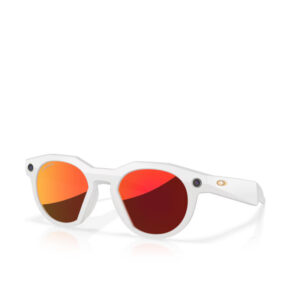
And then there’s the future: sports glasses with integrated AI. It sounds futuristic, but it’s already happening. Think glasses that show your speed or heart rate, automatically adjust the light, have an integrated camera or project live navigation. AI allows your glasses to learn from your way of exercising, smartly filter information and even recognize dangerous situations. Your sports glasses are thus slowly turning into a smart, personal sports coach.
Many people wonder what is actually the difference between sports glasses and everyday glasses. That difference is bigger than you might think. Daily glasses are designed for comfort during work and daily routines, while sports glasses should remain stable during movement, sweat and shock. The fit of sports glasses fits tightly and maintains grip even when you get wet. In addition, sports glasses offer much better protection from wind, dust, sunlight and insects. The lenses are curved for a wide, open field of vision without edges and are made of flexible, impact-resistant materials that can withstand adversity. There is also a difference optically: sports glasses are often curved and have coatings or colors that help with contrast and depth of vision tailored to specific sports. Everyday glasses focus primarily on clear vision and appearance, sports glasses on performance, safety and stability.
So the evolution of prescription sports glasses has been enormous: from the classic glasses that just stuck, to ultra-modern, smart glasses that think with you. Whatever your sport, today there is always a solution that fits your prescription and your way of moving.
De smart sportbrillen
Need advice?
Call us at 085 303 26 73, email info@specialspex.com or start a chat with our team!